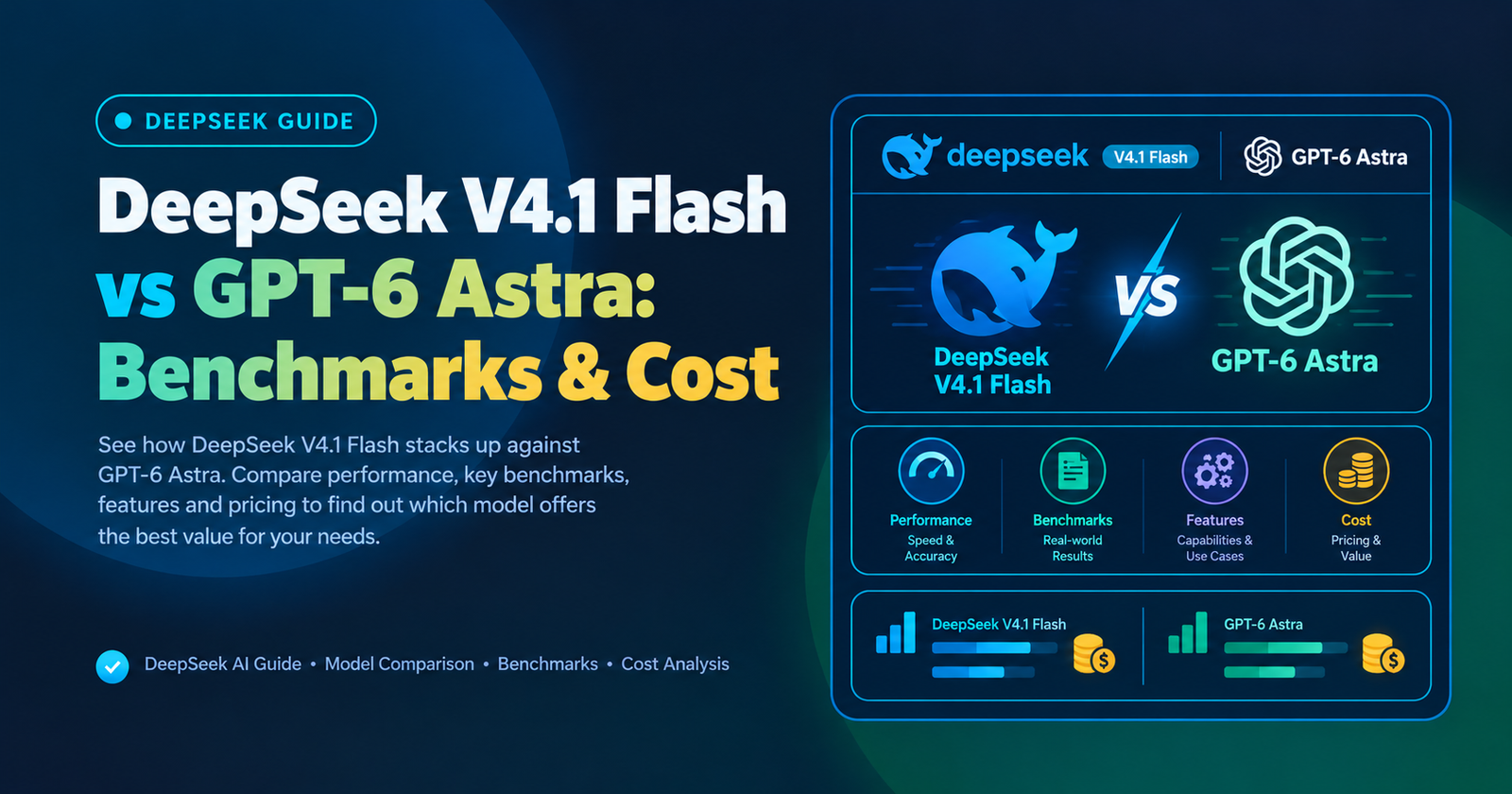
DeepSeek V4.1 Flash vs GPT-6 Astra is a contest between a cheap open-weight model and OpenAI’s premium flagship, and your workload matters more than any leaderboard. Astra wins most independent scoreboards. Flash costs roughly 35 to 47 times less in modeled workloads. This guide covers benchmark data, real costs, a small independent test, setup steps and a version mix-up most comparison pages skip. Sources were reviewed on October 21, 2026.
Which DeepSeek V4.1 Flash Are You Really Comparing?
DeepSeek V4.1 Flash launched on September 10, 2026. On October 17, DeepSeek shipped a post-training update called DeepSeek V4.1 Flash 1017 under the same deepseek-flash API name. Older aliases like deepseek-v4-flash now route to it, so API users were upgraded automatically. DeepSeek says the update improved on all 11 benchmarks it reported and writes shorter outputs.
Why the version matters
Comparison pages mix the two checkpoints. Kingy AI ran its hands-on test on September 10, before the update. BenchLM lists the 1017 model, yet several of its rows cite the September model card. Always check which checkpoint produced a number before you trust it.
DeepSeek V4.1 Flash vs GPT-6 Astra at a Glance
| Spec | DeepSeek V4.1 Flash | GPT-6 Astra |
|---|---|---|
| Maker | DeepSeek | OpenAI |
| Release | Sept 10, 2026 (1017 update Oct 17) | Early Sept 2026 |
| Weights | Open, MIT license | Proprietary |
| Context window | 1M tokens | 1.05M tokens |
| Max output | 384K tokens | 128K tokens |
| Input types | Text, image | Text, image |
| Price per 1M tokens (in / out) | $0.15 / $0.60 off-peak; $0.30 / $1.20 peak | $10 / $50 |
| Cached input per 1M | About $0.003 to $0.006 | $1.00 |
| Availability | DeepSeek API, open weights | Limited availability: OpenAI API, paid ChatGPT plans, Azure, AWS Bedrock |
DeepSeek V4.1 Flash Benchmark Results Against GPT-6 Astra
On BenchLM’s composite index, Astra scores 84.03 and Flash 1017 scores 65.65. Their 90% intervals do not overlap, and Astra ranks #3 on that board against Flash’s #35.
Where Astra clearly leads
The widest gaps appear in hard math and knowledge tests. On FrontierMath Tier 4, Astra reaches 97.6% against 26.8%. On GPQA it scores 96% against 90.9%. It also leads Agents’ Last Exam (59.3% vs 35.4%), ExploitGym (42.4% vs 15.3%) and Terminal-Bench 4.0 (57.9% vs 42.3%).
Where Flash holds its own
Flash is competitive on applied agent work. It scores 77.0% on DeepSWE against Astra’s 74.1%, and 60.5% on AutomationBench against 41.4%. Treat the DeepSeek numbers as vendor-reported.
Why the scoreboard is less clean than it looks
Few results are truly shared
BenchLM tracks 60 public results, but only 16 are shared by both models. Another 28 exist only for Astra. A missing score means “not tested”, not “worse”. Another aggregator, vakati-tech, lists no LiveBench run for either model.
Vendor harnesses move the numbers
DeepSeek’s own card reports 90.6% on Terminal-Bench 2.1, while the independent Vals AI board shows Flash at 74.5% against Astra’s 87.3%. Same benchmark name, different harness, very different story. In the DeepSeek V4.1 Flash vs GPT-6 Astra benchmark debate, always ask who ran the test.
What Each Workload Actually Costs
The DeepSeek V4.1 Flash vs GPT-6 Astra price gap is the biggest fact in the comparison. BenchLM modeled three workloads at list rates:
- Chat turn (1K input, 500 output): $0.0009 vs $0.035
- Repository review (50K input, 3K output): $0.0186 vs $0.65
- Cache-heavy agent loop (200K cached, 20K fresh, 10K output): $0.0192 vs $0.90
Flash’s peak and off-peak pricing means your bill depends on the time of day. Prompt caching drops its input cost much further on repeated prefixes. Aggregators also list different DeepSeek rates, so confirm DeepSeek V4.1 Flash API pricing on the official page.
Per-token price is not cost per correct answer. In Kingy’s test, Astra cost about 7.7 times more per passing trial, far less than the list-price gap, because the ratio counts failures and real token use.
Self-hosting rarely helps at normal scale. BenchLM estimates 50,000 requests a day at about $1,125 a month through DeepSeek’s API versus roughly $27,962 self-hosted, against $45,000 for Astra. The official checkpoint is about 510 GB.
What an Independent Test Showed
Kingy AI ran 24 trials on September 10: two Python repairs, chart reading with strict JSON output, and a mock invoice-ledger tool task, each attempted twice per model.
Astra passed 8 of 8 for $0.09564, with a median API wait of 3.38 seconds. Flash passed 7 of 8 for $0.01092, with a 6.27-second wait. Flash’s one miss came from sending the string “null” where the tool required a JSON null.
Treat this as a signal, not a verdict. It used a tiny sample, low reasoning effort, a 3,072-token output cap and the pre-1017 model. Speed claims also conflict: Zo calls Flash faster, but Kingy measured Astra’s median wait as shorter. Measure latency on your own prompts.
Coding, Agents and Computer Use
Coding
BenchLM’s coding estimate favors Astra, 75.5 to 60.9, though it rates its confidence as limited. For short, checkable jobs and high-volume repository sweeps, Flash’s price makes it very attractive.
Agents and computer use
Astra’s edge is a managed tool stack: computer use, browsing, hosted execution. It posts 72.6% on OSWorld 2.0, and BenchLM lists no matching Flash result. Flash supports tool calls and Responses-style workflows, but you supply the surrounding agent framework.
Routing both
A practical setup uses Flash as the default and escalates to Astra when a task fails validation or needs computer use. You pay premium rates only where they earn their keep.
How to Use DeepSeek V4.1 Flash
If you are wondering how to use DeepSeek V4.1 Flash, there are three routes.
- Chat: the DeepSeek website and app serve
deepseek-flash, which now points to the 1017 update. - API: call the model name
deepseek-flash. It accepts text and images, supports thinking and non-thinking modes, tool calls and Responses-style requests, and returns text. Third-party hosts such as OpenRouter also carry the model, with their own prices. - Open weights: download the MIT-licensed weights from Hugging Face.
Before going live, run 30 to 50 of your own tasks, validate outputs against a schema, and track cost per successful task.
Running the open weights
A hardware reality check
Open weights are not the same as easy deployment. A checkpoint near 510 GB needs serious GPU memory, so most small teams are better off using the hosted API.
DeepSeek V4.1 Flash vs GPT-6 Astra: Pros and Cons
| Model | Pros | Cons |
|---|---|---|
| DeepSeek V4.1 Flash | About 35 to 47x cheaper in modeled workloads; open weights under MIT; 384K output ceiling; strong DeepSWE and AutomationBench results | Trails on math and knowledge tests; few independent scores for 1017; one tool-format slip in testing; heavy to self-host |
| GPT-6 Astra | Leads composite, coding, agentic and math scores; managed tools and computer use; 1.05M context | $10 / $50 per million tokens; proprietary; limited availability; retries get expensive |
Checking Drafts From Either Model
Writers comparing DeepSeek V4.1 Flash vs GPT-6 Astra for drafting should know that no detector can prove which model wrote a passage. Our DeepSeek AI detector gives sentence-level highlights as a starting point, and the ChatGPT detector suits OpenAI-style text. Detectors can lag behind new releases, so treat results as an estimate.
After flagging, you can run a plagiarism check, rework weak passages with the AI paraphraser or the AI humanizer, and confirm length with the word counter. Browse the full set in All Tools.
Which Model Fits Your Workload?
- Choose Flash: high-volume coding agents, document processing, vision on a budget, open-weight control.
- Choose Astra: hard reasoning, advanced math, computer-use agents, high-value tasks where one failure costs more than the API bill.
- Test both: repository-level coding.
FAQ
Which is better in DeepSeek V4.1 Flash vs GPT-6 Astra?
GPT-6 Astra scores higher on most independent boards, including coding, agentic and math. DeepSeek V4.1 Flash wins on price and openness, so “better” depends on your budget and task.
How much cheaper is DeepSeek V4.1 Flash?
Modeled workloads show roughly 35 to 47 times lower cost. Per passing trial in Kingy’s small test, the gap was about 7.7 times.
Is DeepSeek V4.1 Flash open source?
Its weights are published under the MIT license, so it is open-weight. That is not the same as a fully reproducible training process.
Is DeepSeek V4.1 Flash 1017 the same model?
It is an October 17 update to V4.1 Flash, served under the same deepseek-flash name. Benchmark numbers from before that date may describe the older checkpoint.
Can a detector tell these models’ text apart?
Not reliably. Detectors estimate AI patterns and cannot prove authorship by a specific model.
Conclusion
In DeepSeek V4.1 Flash vs GPT-6 Astra, there is no single winner. Astra is the stronger model on most published and independent measures, and it adds managed tools and computer use. Flash delivers a large share of that value at a small fraction of the cost, with open weights as a bonus. Before choosing, confirm which Flash checkpoint a score refers to, then test both on your own tasks and judge by cost per successful result.


