
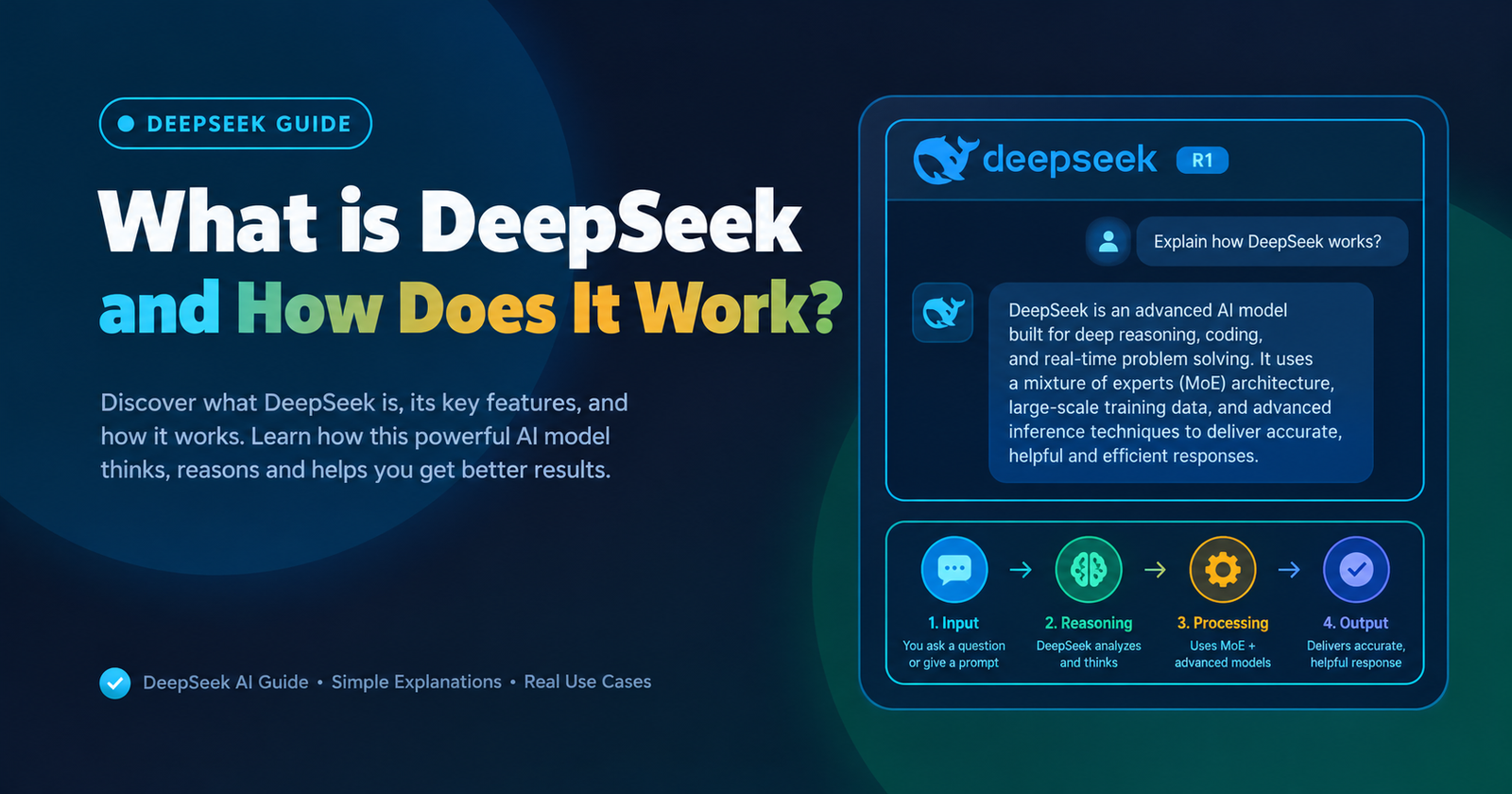
When exploring modern artificial intelligence, you have likely encountered the question: what is DeepSeek and why has it disrupted the global technology landscape? Developed by Hangzhou-based DeepSeek AI, this frontier open-weights ecosystem combines cutting-edge Mixture-of-Experts (MoE) neural architectures, Multi-Head Latent Attention (MLA), and reinforcement learning to deliver performance on par with proprietary giants like OpenAI and Anthropic—at a tiny fraction of the computational training cost.
Whether you are an engineer looking to understand how does DeepSeek work behind the scenes, a researcher evaluating deepseek capabilities, or a creator learning what is DeepSeek used for in daily workflows, understanding this platform is essential. In this comprehensive technical guide, you will explore the full spectrum of deepseek technology, examine the dual-model architecture of DeepSeek-V3 and DeepSeek-R1, assess real-world deepseek usage, and understand how to audit and verify AI-generated text using DeepSeek AI Detector.
What is DeepSeek? Origins, Meaning, and Platform Overview
To understand what is deep seek ai, you must look at its origins. Founded in 2023 by financial quantitative research fund High-Flyer, DeepSeek was created with a mission to develop artificial general intelligence (AGI) through mathematically rigorous, resource-efficient open-source models. The literal deepseek meaning reflects an analytical mandate: diving into the deepest representations of neural latent space to extract pure reasoning capabilities rather than simply scaling brute-force compute.
Unlike traditional closed-source AI vendors who treat their models as proprietary black boxes, the deepseek platform publishes complete open weights, comprehensive technical whitepapers, and reproducible training recipes under permissive open licenses. When people ask what does deepseek do, the answer spans far beyond a standard web chatbot. Artificial intelligence deepseek represents a complete ecosystem consisting of:
- DeepSeek-V3: A 671-billion total parameter Mixture-of-Experts base foundational model that only activates 37 billion parameters per token, providing blazing-fast inference and remarkable general-purpose language fluency.
- DeepSeek-R1: A frontier reasoning model trained via large-scale pure reinforcement learning (RL) without human supervision shortcuts, capable of mathematical deduction, complex algorithmic planning, and self-verifying chain-of-thought logic.
- DeepSeek-Coder: Highly specialized developer-focused models trained on billions of lines of source code across 80+ programming languages.
- DeepSeek-VL & Janus: Multimodal vision-language models capable of analyzing diagrams, charts, and generating visual tokens (read our dedicated investigation: Can DeepSeek AI Generate Images?).
Key Fact: Why DeepSeek Shocked the Global AI Industry
While frontier proprietary models historically required hundreds of millions of dollars in compute, DeepSeek-V3 was trained on a cluster of only 2,048 NVIDIA H800 GPUs over approximately two months, costing less than $6 million in total GPU compute. This proved that algorithmic elegance and mathematical efficiency can compete directly with multi-billion-dollar infrastructure.
How Does DeepSeek Work? Inside the Transformer & MoE Architecture
To truly grasp how does deepseek work, you need to examine the mathematical innovations that separate its architecture from standard dense transformer models. Traditional Large Language Models (such as GPT-3.5 or standard LLaMA configurations) activate every single neural parameter for every generated word. DeepSeek radically alters this paradigm using two foundational technologies:
1. Multi-Head Latent Attention (MLA)
In conventional multi-head attention (MHA), serving long-context prompts requires storing vast amounts of Key-Value (KV) cache memory. For enterprise servers, KV cache quickly becomes the primary bottleneck limiting throughput. DeepSeek introduced Multi-Head Latent Attention, which compresses the Key and Value matrices into low-dimensional latent vectors prior to inference.
During generation, the compressed latent representations are projected back dynamically. This reduces KV cache memory consumption by up to 93% compared to standard attention mechanisms, allowing you to run massive context windows (up to 128,000 tokens) on substantially more affordable server configurations.
2. DeepSeekMoE: Fine-Grained Mixture of Experts
While legacy MoE architectures (like Mixtral 8x7B) split neural networks into a small handful of large experts (e.g., 8 experts where 2 are chosen), DeepSeek pioneered Fine-Grained MoE. In DeepSeek-V3:
- The model is partitioned into 256 individual micro-experts plus dedicated shared experts that are permanently active.
- For every token processed, an intelligent gating router dynamically evaluates probability distributions and routes the token to the top 8 micro-experts.
- This results in 671 billion total parameters of deep factual memory, but only 37 billion active parameters per token compute cost.
3. DualPipe: Overlapping Computation and Communication
In large-scale distributed training, GPUs spend significant time waiting for tensor activations and gradients to transfer across network nodes. DeepSeek developed DualPipe, an innovative pipelining algorithm that schedules forward and backward passes concurrently. By overlapping computation with inter-GPU communication across InfiniBand networks, DualPipe almost completely hides communication overhead, enabling near 100% linear cluster scaling efficiency.
| Architectural Component | Traditional Dense LLMs | DeepSeek-V3 / DeepSeek-R1 |
|---|---|---|
| Active Compute | 100% of parameters active on every token | Fine-grained MoE: 37B active out of 671B |
| KV Cache Footprint | Heavy Multi-Query / Multi-Head Attention | Multi-Head Latent Attention (MLA) ~93% compression |
| Reasoning Process | Supervised Fine-Tuning (SFT) mimicry | Self-verifying Large-Scale Reinforcement Learning (R1-Zero) |
| Open Availability | Proprietary API paywalls | Fully open weights (Hugging Face / Ollama / GitHub) |
DeepSeek AI Features & Capabilities: What Can DeepSeek Do?
When evaluating what can deepseek do, you will discover that its capabilities span analytical, creative, and software engineering domains. The combination of high-density domain knowledge and deliberate chain-of-thought verification provides several standout deepseek ai features:
Mathematical Problem Solving & Formal Proofs
On standard mathematical benchmarks like MATH-500 and AIME (American Invitational Mathematics Examination), DeepSeek-R1 achieves state-of-the-art results exceeding 96%, matching OpenAI’s specialized o1 model. Rather than guessing intermediate formulas, DeepSeek generates an explicit internal chain of thought wrapped in reasoning blocks, allowing it to double-check its arithmetic and backtrack when a step leads to a contradiction.
Enterprise Software Development & Code Refactoring
Software engineers using deepseek consistently highlight its nuanced handling of complex codebases. The model excels at:
- Architecting full-stack applications in Next.js, React, Python, Go, and Rust.
- Debugging race conditions, memory leaks, and complex async runtime issues.
- Translating legacy codebases (such as COBOL or Fortran) into modern typed languages.
- Writing comprehensive unit, integration, and end-to-end test suites.
Long-Form Research, Synthesis & Academic Writing
With native 128K context window support, deepseek capabilities allow you to upload complete research papers, financial prospectuses, and multi-chapter book manuscripts. The model extracts key thesis points, identifies structural contradictions, and organizes complex analytical summaries without suffering from needle-in-a-haystack recall loss.
DeepSeek-V3 vs DeepSeek-R1: Dual Model Ecosystem Explained
A common point of confusion when exploring what is deepseek ai is understanding the distinction between DeepSeek-V3 and DeepSeek-R1. While they share identical underlying MoE dimensions, their training methodologies and intended use cases diverge significantly:
DeepSeek-V3 (Conversational Generalist)
Trained on 14.8 trillion high-quality multilingual tokens with extensive supervised fine-tuning. It responds immediately with high conversational fluency, making it ideal for translation, summarization, creative brainstorming, and rapid chat workflows.
Best for: Fast chat, copy editing, and general tasks.
DeepSeek-R1 (Deep Reasoning Engine)
Trained with large-scale reinforcement learning (Group Relative Policy Optimization – GRPO). Before answering, it pauses to generate an internal <think> chain of verification steps, evaluating edge cases and correcting initial mistakes.
Best for: Hard mathematics, complex algorithms, and logic proofs.
What is DeepSeek Used For? Real-World DeepSeek Usage Across Industries
Understanding what is deepseek good for in professional environments helps determine how to deploy it effectively. Current deepseek usage spans multiple commercial and creative sectors:
1. Academic & Scientific Research
Academics use DeepSeek-R1 to review literature, formalize mathematical proofs, draft LaTeX manuscripts, and verify statistical hypotheses.
2. Local Privacy-Compliant Enterprise AI
Because weights are open, healthcare institutions and financial firms deploy distilled DeepSeek models (1.5B, 7B, 14B, 32B) on local air-gapped servers to ensure zero patient or customer data leakage.
3. Roleplay & Conversational Agents
Thousands of interactive storytellers connect DeepSeek to platforms like Janitor AI and SillyTavern for rich narrative creation (see our step-by-step setup guide: How to Set Up DeepSeek on Janitor AI).
4. Content Creation & Technical Copywriting
Marketing agencies use DeepSeek to brainstorm angles, draft technical documentation, and write long-form articles, pairing output with editorial proofing tools like our DeepSeek Sentence Checker.
Developer Integration: Connecting to the DeepSeek API
Because DeepSeek’s server API is strictly OpenAI-compatible, integrating DeepSeek into your Python or Node.js applications requires only altering the base URL and API key. Here is a complete production-grade example using Python:
// Python Integration using OpenAI SDK with DeepSeek Base URL
from openai import OpenAI

client = OpenAI(
    api_key="your-deepseek-api-key-here",
    base_url="https://api.deepseek.com"
)

response = client.chat.completions.create(
    model="deepseek-chat",  # or "deepseek-reasoner" for R1 chain-of-thought
    messages=[
        {"role": "system", "content": "You are an expert computational linguist."},
        {"role": "user", "content": "Explain the architectural advantages of Multi-Head Latent Attention."}
    ],
    temperature=0.7,
    max_tokens=1500
)

print(response.choices[0].message.content)
DeepSeek Platform: How to Access and Use DeepSeek
If you want to use deepseek today, several official and third-party access methods exist depending on your technical preferences:
- Official Web Chat (chat.deepseek.com): The quickest way to interact with DeepSeek-V3 and DeepSeek-R1 with zero installation. You can toggle between “DeepThink” (R1 reasoning mode) and standard conversational search.
- Mobile Applications: Native iOS and Android apps offer intuitive voice input, chat history synchronization, and instant response streaming.
- Official DeepSeek REST API: Fully OpenAI-compatible API endpoints allowing developers to switch their existing applications by simply changing the `base_url` to `https://api.deepseek.com` and specifying `deepseek-chat` or `deepseek-reasoner`.
- Local Self-Hosting via Ollama: For 100% private execution, you can run distilled models locally on your MacBook or PC using a single terminal command:
ollama run deepseek-r1:8b
Detecting DeepSeek Generated Content: Why You Need DeepSeek AI Detector
As millions of students, copywriters, and developers embrace DeepSeek, distinguishing between authentic human writing and synthetic DeepSeek output has become critical for educators, webmasters, publishers, and recruitment specialists.
DeepSeek models exhibit distinct statistical footprints. Because DeepSeek relies on reinforcement learning with verifiable reward signals, its generated prose often displays:
- Uniform Token Perplexity: Sentences maintain predictable next-token probability distributions without the organic variance seen in human drafts.
- Symmetrical Syntactic Cadence: Balanced sentence structures with regular clause lengths, contrasting with the high “burstiness” of human authors who naturally alternate between short punchy sentences and complex parenthetical thoughts.
- Characteristic Connective Cliches: Frequent occurrences of structured transition formulas such as “Consequently,” “In essence,” “It is crucial to consider,” and balanced tripartite lists.
To safeguard editorial integrity, verify student coursework, or audit freelance submissions, you can use our free browser-native DeepSeek AI Detector. It scans documents against transformer token log-likelihood models, measures sentence-level burstiness entropy, and provides a clear color-coded probability breakdown without uploading your text to third-party databases.
Limitations and Safety Considerations When Using DeepSeek
While deepseek ai capabilities are impressive, responsible usage requires awareness of key boundaries:
- Occasional Hallucinations: Like all transformer models, DeepSeek can confidently invent citations, historical dates, or library APIs when operating on ambiguous prompts. Always verify mission-critical facts.
- Server Congestion during Peak Hours: Due to unprecedented global demand, the official web chat interface occasionally experiences rate limiting or temporary latency spikes.
- Content Moderation Alignment: Official web endpoints implement Chinese regulatory compliance filters on sensitive political inquiries. However, open weights downloaded from Hugging Face or run through local Ollama instances allow complete uncensored research.
Frequently Asked Questions (FAQ) About DeepSeek
Is DeepSeek completely free to use?
Yes. The official web interface (chat.deepseek.com) and mobile apps are 100% free with no mandatory monthly subscription fees. If you use the developer API, pricing is among the lowest in the entire AI industry at approximately $0.14 per 1 million input tokens.
How does DeepSeek compare directly to ChatGPT?
In mathematics, competitive coding, and raw logic benchmarks, DeepSeek-R1 performs at or above OpenAI’s o1 and GPT-4o. ChatGPT maintains advantages in native multimodal image generation (via DALL-E 3) and seamless consumer voice mode. For a detailed breakdown, read our head-to-head analysis: DeepSeek vs ChatGPT: Which AI Model is Best?.
Can DeepSeek write code and fix programming errors?
Yes, software engineering is one of DeepSeek’s strongest core competencies. It generates complete code files, writes unit tests, explains intricate algorithm complexity, and can debug complex stack traces across Python, JavaScript, TypeScript, C++, and Go.
Is my data safe when using DeepSeek?
When using the web interface, inputs are subject to DeepSeek’s standard terms of service. For maximum privacy and zero data exposure, enterprise users and privacy-conscious researchers download the open model weights to run completely offline on self-hosted hardware.
What is DeepSeek distillation and how does it work?
DeepSeek distilled the reasoning patterns discovered by DeepSeek-R1 into smaller dense student models (such as Llama-8B, Qwen-14B, and Qwen-32B). This allows lightweight models to exhibit advanced chain-of-thought mathematical reasoning on consumer laptops without needing massive server clusters.
Can DeepSeek analyze uploaded PDF documents?
Yes, DeepSeek supports uploading documents up to 128,000 context tokens. You can upload technical PDFs, research papers, and spreadsheets, querying the model for detailed summaries, data extraction, or comparative auditing.
Summary & Next Steps: DeepSeek represents a generational milestone in transparent, cost-efficient, and mathematically rigorous artificial intelligence. Explore its reasoning power, experiment with its developer APIs, and verify synthetic text anytime using our free DeepSeek AI Detector.


