Is DeepSeek Better Than ChatGPT?
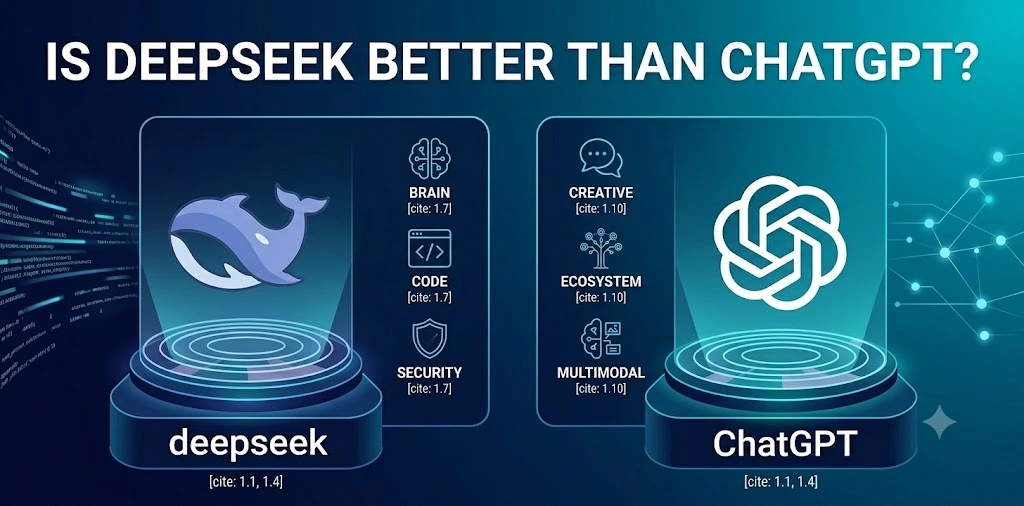
Everyone seems to have a take on this. DeepSeek exploded onto the scene in early, briefly overtook ChatGPT on the App Store, and sent shockwaves through the AI industry. Now, more than a year later, the question “is DeepSeek better than ChatGPT?” is still one of the most searched comparisons in AI.
The honest answer? It depends entirely on what you need it to do. Neither model wins across the board. What has changed in 2026 is that the gap between them has narrowed significantly on raw performance, while the differences that remain — privacy, cost, use-case fit — are the ones that actually shape your decision.
This breakdown covers benchmarks, real-world use cases, privacy risks, and pricing so you can make a clear call.
What Are DeepSeek and ChatGPT, Really?
Before comparing scores, it helps to understand what each model was built for. They come from completely different philosophies, and that shapes everything from how they respond to where your data goes.
DeepSeek: The Open-Source Challenger
DeepSeek is developed by a Chinese AI research company and released as open source under an MIT license. Its most notable achievement was training its V3 model for a reported $5.5 million — a fraction of what OpenAI spent on GPT-4. The latest release as of mid-2026 is DeepSeek V4, available in two variants: V4 Flash (the default chat model) and V4 Pro (a heavy reasoning model with 1.6 trillion total parameters and a 1 million token context window).
DeepSeek was built with a specific philosophy: efficient, transparent reasoning at low cost. Its open-source nature means developers can self-host the model entirely, which removes data privacy concerns from the equation if you choose that route.
Also Read: What Is DeepSeek
ChatGPT: The Established All-Rounder
ChatGPT is developed by OpenAI and runs on proprietary models. As of 2026, the flagship is GPT-5.5, supporting a 1.05 million token context window. ChatGPT has scaled to 900 million weekly active users and sits inside a mature product ecosystem that includes image generation via DALL-E, voice mode, memory, plugins, and native desktop apps.
ChatGPT was never built for one thing. It was built to be useful across everything writing, coding, research, conversation, analysis and its broad training reflects that.
DeepSeek vs ChatGPT Benchmarks: What the Numbers Say
Benchmarks aren’t everything, but they reveal where each model is genuinely strong rather than where marketing says it is.
Math and Reasoning
This is where DeepSeek has made its biggest impression. DeepSeek R1 scores approximately 97.3% on the MATH-500 benchmark, while GPT-4o, the default ChatGPT model for many users, scores around 60.3% on the same test. OpenAI’s o3 model closes the gap significantly at 99.2%, but that comes at a much higher price point.
DeepSeek’s chain-of-thought reasoning approach is what drives this performance. It breaks problems down step by step and shows its work, which is especially useful when you need to follow the logic rather than just receive an answer.
Coding Performance
Both models are strong coders, but they have different strengths. As of early 2026, DeepSeek V3.2 sits at 73.1% on the SWE-Bench Verified leaderboard, while OpenAI’s GPT-5.3 Codex variant leads at 80%. In practice, DeepSeek tends to give cleaner, more direct code output without lengthy explanations something developers often prefer when they are in a workflow and don’t need narration. DeepSeek Coder V2 is particularly sharp on LeetCode-style logic puzzles and math-heavy coding challenges, trained on a 6 trillion token technical dataset.
General Knowledge and Writing
ChatGPT holds a clear edge here. It outperforms DeepSeek on general knowledge tasks (MMLU benchmarks), handles nuanced conversational context better, and produces text that reads more naturally in English. Its writing, essays, and marketing copy output is polished in a way that DeepSeek does not consistently match. If your primary use is generating readable, human-quality prose, ChatGPT is the stronger tool.
Which Is Better for Your Specific Use Case?
The benchmark numbers only tell part of the story. How each model performs in real-world scenarios is what actually matters for most users.
For Studying and Research
DeepSeek appeals to students and researchers because of its transparent chain-of-thought reasoning. You can see how it arrived at an answer, which helps with actually understanding material rather than just copying an output. It performs particularly well on structured, analytical tasks like summarizing research papers, solving problem sets, and breaking down complex logic.
ChatGPT, however, remains the stronger option for literature summaries, essay drafts, and tasks that require broad contextual knowledge. Its 1 million token context window means it can handle very long documents in a single session without losing track of earlier content.
For Medical Students
DeepSeek R1 has shown strong performance on the USMLE (United States Medical Licensing Examination), outperforming ChatGPT in exact answer retrieval for multiple-choice medical questions. Its capacity for extractive precision — pulling the correct answer from structured medical content — gives it an edge when studying for high-stakes clinical exams.
That said, ChatGPT’s broader medical knowledge base, ability to interpret images, and natural explanatory style make it better suited for conceptual understanding and patient communication practice. The choice comes down to what you are preparing for: exam drilling or broader clinical reasoning.
For Coding
DeepSeek is the stronger choice for focused, technical coding work. It is faster, leaner in its explanations, and competitive with GPT-4-class models at a fraction of the API cost. Developers building cost-sensitive applications or processing large volumes of code stand to benefit significantly.
For agentic tasks — where the AI interacts with tools, browsers, and APIs autonomously — GPT-5.5 currently leads. If you need an AI to manage multi-step workflows rather than just write functions, ChatGPT has the edge.
For Essay Writing and Creative Work
ChatGPT wins here without much debate. Its language fluency, contextual awareness, and ability to match tone make it the go-to for essays, marketing copy, storytelling, and any content that needs to sound distinctly human. DeepSeek produces accurate and well-structured text, but it leans technical. Extended creative or persuasive writing tends to feel more mechanical compared to ChatGPT’s output.
For the Environment
DeepSeek’s training cost and inference efficiency have made it a talking point in AI sustainability discussions. Training DeepSeek V3 reportedly cost around $5.5 million, compared to over $100 million for GPT-4. Lower training costs generally translate to lower energy consumption. At the inference level, DeepSeek’s mixture-of-experts architecture only activates a fraction of its total parameters per query, which means it uses significantly less compute per response than a dense model of equivalent size. For organizations thinking about the environmental footprint of their AI usage, DeepSeek’s efficiency model is genuinely notable.
The Privacy Problem You Can’t Ignore
This is the area where the comparison shifts most sharply in ChatGPT’s favor — and it deserves direct attention rather than a footnote.
DeepSeek stores all user data on servers in China. Under China’s 2017 National Intelligence Law, organizations must cooperate with government intelligence requests with no obligation to notify users. Security researchers have documented that the DeepSeek iOS app disables App Transport Security, a standard iOS feature that enforces secure connections. A database breach exposed over one million records, and mobile security firm NowSecure identified hardcoded encryption keys in the app a fundamental security failure.
Multiple countries, including Italy, Australia, Taiwan, and South Korea, have banned DeepSeek from government devices. Several U.S. agencies have done the same.
ChatGPT operates under Western privacy regulations and does not share data with advertisers. It is not without its own criticisms, but it does not carry the state-level data access risk that DeepSeek does.
For casual, non-sensitive use, this may not change your decision. For professional, medical, or business use, it should.
The exception: if you self-host DeepSeek on your own infrastructure using its open-source weights, the data residency concern disappears entirely. This is what many enterprise teams in privacy-sensitive industries have done to capture the cost benefit without the risk.
Pricing: Where DeepSeek Pulls Way Ahead
This is DeepSeek’s clearest, most measurable advantage.
DeepSeek API pricing sits at roughly $0.435 per million input tokens for V4 Pro, compared to $2.50 per million for GPT-5.4. For cache-heavy workloads, the difference can reach 31x in DeepSeek’s favor. DeepSeek R1 is approximately 27 times cheaper than OpenAI’s o1 for reasoning tasks.
For individual users, ChatGPT Plus at $20 per month remains a well-priced entry point into frontier-class AI. DeepSeek’s free tier is generous and competitive.
For developers and teams processing large volumes of content, the math changes dramatically. At scale, DeepSeek’s API pricing delivers GPT-4-class capability at commodity prices.
DeepSeek vs ChatGPT vs Claude: A Quick Comparison
Many users are also asking how DeepSeek stacks up against Claude. Here is a high-level comparison across the three most commonly used models in 2026:
- DeepSeek V4 Pro — Strongest on math, coding, and cost efficiency. Open source. Privacy concerns for cloud API use. Best for technical and developer use cases.
- ChatGPT (GPT-5.5) — Best all-rounder. Strongest on creative writing, multimodal tasks, and agentic workflows. Highest price at scale.
- Claude (Anthropic) — Strong on long-document analysis, nuanced reasoning, and privacy. Does not sell user data and operates under stricter Western privacy frameworks. Particularly well-regarded for writing quality and handling sensitive contexts.
Each model has a context where it outperforms the others. Increasingly in 2026, enterprise teams use more than one.
Does It Matter Which AI Wrote Your Content?
Here is something most comparison articles skip entirely: the question of transparency around AI-generated content.
Whether you use DeepSeek, ChatGPT, or any other model to produce written work, the output can be detected. Educators, employers, and publishers are increasingly using AI content detection tools to verify whether submitted work was written by a person or generated by a model.
If you are a student, content creator, or professional who uses AI as part of your workflow, you should know what a detection tool sees in your output. The DeepSeek AI Checker offers sentence-level detection across all major models including DeepSeek, ChatGPT, Claude, Gemini, and Grok and returns results in under three seconds.
For content teams specifically, detecting AI patterns before publishing is a practical step toward maintaining search performance. Google’s guidance has consistently favored content that demonstrates genuine expertise, and AI-heavy text can work against that. The ChatGPT Detector on DeepSeek AI Checker handles GPT-generated content with the same sentence-level accuracy as DeepSeek detection.
If you are checking for unintentional AI patterning in your own writing something that happens when people heavily edit AI drafts the DeepSeek Sentence Checker flags exactly which sentences carry the highest AI signal so you know what to rewrite.
Frequently Asked Questions
Is DeepSeek better than ChatGPT in 2026?
For math, coding, and cost efficiency at scale, DeepSeek is the stronger choice. For creative writing, multimodal tasks, privacy, and general usability, ChatGPT leads. Neither is universally better — the right answer depends on your specific task and risk tolerance.
Is DeepSeek better than ChatGPT for studying?
DeepSeek’s transparent chain-of-thought reasoning makes it particularly useful for subjects that involve logical problem-solving, math, and technical analysis. ChatGPT is better for essay writing, literature summaries, and tasks that require broad contextual knowledge.
Is DeepSeek better than ChatGPT for medical students?
DeepSeek R1 has outperformed ChatGPT on USMLE multiple-choice questions, particularly in extractive precision. For exam preparation and clinical reasoning drills, it holds an edge. ChatGPT is stronger for conceptual explanations and multimodal learning.
Is DeepSeek better than ChatGPT for coding?
For focused coding tasks, cost-sensitive API use, and technical problem-solving, DeepSeek is competitive with or ahead of GPT-4-class models. For agentic coding workflows that require multi-step tool use, ChatGPT currently leads.
Is DeepSeek better than ChatGPT for essay writing?
No. ChatGPT produces more natural, fluid prose and handles creative and persuasive writing more consistently than DeepSeek. For essay writing, ChatGPT is the stronger tool.
Is DeepSeek better than ChatGPT for the environment?
DeepSeek’s efficient architecture and lower training cost give it a meaningful advantage in energy efficiency. Its mixture-of-experts design activates fewer parameters per query than a comparable dense model, resulting in lower compute per response.
Is DeepSeek safe to use?
For casual, non-sensitive use, the risk is low. For professional or business use, DeepSeek’s data storage in China and documented security vulnerabilities represent real concerns. Self-hosting DeepSeek’s open-source model eliminates the data residency issue entirely.
Is DeepSeek better than Claude?
DeepSeek outperforms Claude on math and coding benchmarks and is significantly cheaper at the API level. Claude is generally considered stronger for nuanced writing, long-document analysis, and privacy-sensitive use cases, as Anthropic operates under stricter data policies.
The Bottom Line
The era when ChatGPT had no real competition is over. DeepSeek V4 is a genuine frontier model that matches or exceeds GPT-5.5 on several technical benchmarks at a fraction of the cost.
If you need the best all-purpose AI with a polished interface, creative capabilities, multimodal support, and trusted privacy practices, ChatGPT remains the default choice for most users.
If you need maximum reasoning and coding performance per dollar, are building cost-sensitive applications, or want to self-host for data sovereignty, DeepSeek is the smarter pick.
The question is no longer which is smarter. It is which trade-offs make sense for you.