Is DeepSeek Safe?
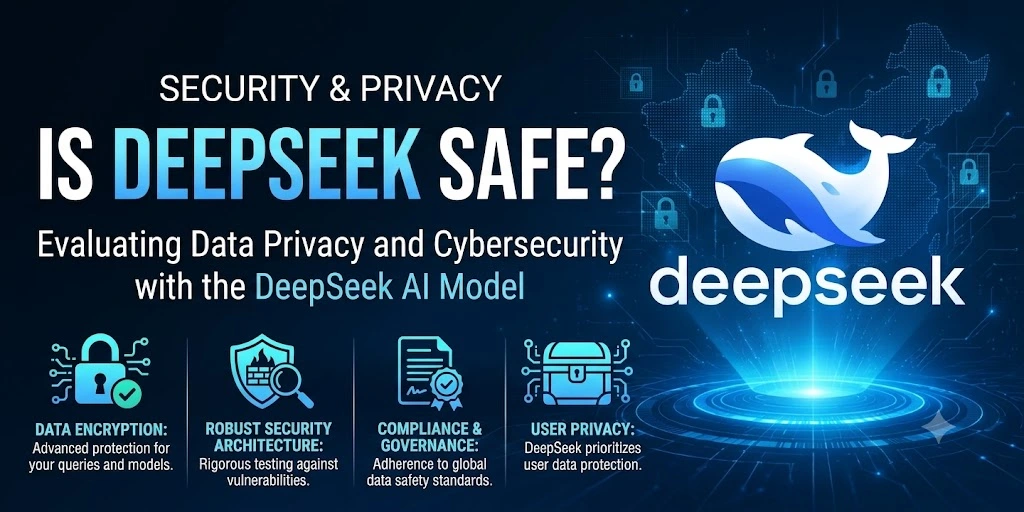
DeepSeek is not considered fully safe for privacy-sensitive use. While it works well as a general AI tool, cybersecurity experts, multiple governments, and major organizations have raised serious concerns about data collection, weak security infrastructure, and the storage of user data on servers in China.
If you are using DeepSeek for casual tasks, the risk is lower. But if you are sharing personal, business, or sensitive information, you should understand the risks before proceeding.
🔑 Key Takeaways
- DeepSeek collects extensive user data and stores it on servers in China under Chinese jurisdiction
- Security researchers found a fully exposed database containing plaintext chat histories and API keys
- Dozens of governments, agencies, and major corporations have banned or restricted DeepSeek
- For business, government, or sensitive personal use, DeepSeek is not a safe choice
- The safest option for technical users is running DeepSeek locally on your own device
- DeepSeek censors politically sensitive topics, making it unreliable for objective information
- As DeepSeek-generated content spreads online, using a DeepSeek AI Checker helps verify content authenticity
What Is DeepSeek AI?
DeepSeek is a Chinese artificial intelligence company that released its AI chatbot and large language model (LLM) in January 2025. The app is powered by the DeepSeek R1 and DeepSeek V3 models, which quickly gained global attention for their impressive performance.
Within days of launch, DeepSeek surpassed ChatGPT as the most downloaded free app on both Apple’s App Store and Google Play in the United States. It offers capabilities comparable to GPT-4, including advanced reasoning, coding assistance, math problem solving, and natural language processing all for free.
This rapid rise in popularity made DeepSeek one of the most talked-about AI tools. But with that popularity came serious scrutiny.
Is DeepSeek Safe to Use?
The honest answer is: it depends on how you use it.
For general, non-sensitive tasks like brainstorming ideas, writing casual content, or exploring coding concepts, DeepSeek functions without causing direct harm to your device. It does not contain malware in the traditional sense.
However, cybersecurity researchers, government agencies, and privacy watchdogs have all flagged DeepSeek as potentially unsafe when it comes to data privacy. The core issue is not what DeepSeek does on your device it is what happens to your data after you submit it.
Here is a simple breakdown:
| Use Case | Safety Level |
|---|---|
| Casual creative writing | Moderate risk |
| Work or business tasks | High risk |
| Sharing personal details | High risk |
| Government or sensitive work | Very high risk |
| General research questions | Lower risk |
If your use involves anything confidential, DeepSeek is not the safe choice.
DeepSeek Privacy Risks: What Data Does It Collect?
According to DeepSeek’s own privacy policy, the app collects a significant amount of user data, including:
- Every chat history and prompt you submit
- Your account information including email address and phone number
- Device information and identifiers
- IP address and location data
- Keystroke patterns and behavioral data
- Any files or content you upload
The most critical concern is where this data goes. DeepSeek stores all user data on servers located in China. Under China’s national security and cybersecurity laws, the Chinese government has the legal authority to demand access to this data at any time — and companies operating in China are legally required to comply.
This is a fundamentally different situation from using AI tools like ChatGPT, Claude, or Gemini, which store data under US or EU legal frameworks with clearer user protections.
Additionally, hidden code discovered in DeepSeek’s app was found to be sending user data to China Mobile, a Chinese state-controlled telecommunications company even though China Mobile is banned from operating in the United States due to national security concerns.
Security Vulnerabilities Found in DeepSeek
Beyond the data storage concerns, security researchers have uncovered concrete technical vulnerabilities in DeepSeek’s infrastructure and mobile apps.
Exposed Database With No Protection
In early 2025, security firm Wiz Research discovered a publicly accessible DeepSeek database with absolutely no authentication or access controls. This database contained plaintext chat histories, API keys, and internal system data. Anyone who found it could have accessed, modified, or downloaded all of that information. DeepSeek secured the database after Wiz reported the issue, but the exposure had already occurred.
iOS App Security Problems
Mobile security firm NowSecure analyzed the DeepSeek iOS app and found that Apple’s App Transport Security (ATS) was disabled. ATS is specifically designed to prevent apps from transmitting data without encryption. With it disabled, some user registration and device information was sent in an unencrypted state — meaning anyone on the same network, such as a shared Wi-Fi connection, could potentially intercept it.
The iOS app also used Triple DES (3DES) encryption, an outdated method that modern security standards have deprecated. It also contained hardcoded encryption keys — keys built directly into the app and shared across all users — which makes intercepted data much easier to decrypt.
Android App Issues
SecurityScorecard’s analysis of the DeepSeek Android app revealed similar problems, including hardcoded encryption keys and a SQL injection vulnerability that could potentially allow attackers to manipulate the app’s data handling.
These are not minor issues. They represent foundational security failures that most reputable AI platforms do not have.
Countries and Organizations That Have Banned DeepSeek
The response from governments and major institutions has been swift and widespread. Here is a summary of key actions taken:
Government Bans and Restrictions:
- Italy — First country to act. Blocked DeepSeek from app stores after the company failed to respond adequately to GDPR data practice questions
- Australia — Banned DeepSeek from all government devices and systems, citing national security risks
- Taiwan — Prohibited across all public sector organizations, state-owned enterprises, public schools, and critical infrastructure
- South Korea — Temporarily suspended downloads nationwide; multiple government ministries banned use on official devices
- Czech Republic — Banned from all public administration use due to data security concerns
- Germany — Requested Apple and Google remove DeepSeek from their app stores
- India — Finance ministry instructed employees to avoid DeepSeek for any official work
- France, Ireland, Belgium — Launched formal investigations into DeepSeek’s data practices
US Agency Bans:
- NASA — Blocked from all agency systems and employee devices
- US Navy — Service members prohibited from any use, including personal devices
- Pentagon — Blocked after unauthorized staff access incidents
- US Congress — Restricted on official devices; House offices warned against use
- Department of Commerce — Banned on all government-furnished equipment
Corporate Bans:
- Microsoft — Does not allow employees to use DeepSeek
- News Corp — Banned due to security and privacy risks
- Mitsubishi Heavy Industries — Banned for all employees
This level of institutional rejection across governments and major corporations is significant. It reflects a genuine consensus among security professionals that DeepSeek poses real risks for sensitive data.
Is DeepSeek Safe for Businesses?
For businesses, the risks are considerably higher than for individual casual users.
When employees use DeepSeek for work tasks, they may unknowingly feed the AI proprietary company information, client data, financial details, internal strategies, or confidential communications. All of that information becomes part of what DeepSeek processes and stores on Chinese servers.
If your business operates under regulations such as GDPR, HIPAA, SOC 2, or other data compliance frameworks, using DeepSeek could put you in direct violation of those requirements. Several EU regulators have already determined that DeepSeek’s data handling does not meet GDPR standards.
For any business handling sensitive customer or operational data, DeepSeek should be treated as a prohibited tool until it can demonstrate compliance with international data protection standards.
DeepSeek Content Censorship: A Hidden Risk
One aspect of DeepSeek safety that receives less attention is political content censorship. Users and researchers have widely documented that DeepSeek refuses to answer or significantly limits its responses on topics that are politically sensitive from the perspective of the Chinese government.
Topics including Tiananmen Square, Taiwan’s political status, Tibet, and criticism of the Chinese Communist Party consistently result in refusals, deflections, or heavily filtered responses. This is not just a content moderation policy — it reflects an ideological bias built into the model’s training and instruction tuning.
For users who need an AI that provides objective, uncensored information on global events and political history, this is a meaningful limitation.
How to Use DeepSeek More Safely
If you decide to use DeepSeek despite the known risks, here are practical steps to reduce your exposure:
- Never share personal identifying information — avoid your real name, address, phone number, or financial details
- Do not use it for work tasks involving client data, proprietary information, or anything confidential
- Avoid using it on public Wi-Fi where unencrypted data transmissions are more vulnerable
- Use a VPN to mask your IP address and location, though note that a VPN does not protect the content of your prompts
- Use the local/self-hosted version if available — running DeepSeek models locally through tools like Ollama means your data does not leave your device
- Never upload sensitive documents — assume anything you upload could be stored indefinitely
For government employees, healthcare workers, legal professionals, and anyone handling regulated data, the safest recommendation is to avoid DeepSeek entirely for work-related purposes.
DeepSeek AI-Generated Content: A New Risk You Should Know
Beyond the privacy and security questions, there is another concern that is becoming increasingly relevant: the rise of DeepSeek-generated content across the web.
As DeepSeek becomes more widely used, AI-generated text produced by DeepSeek models is appearing in articles, blog posts, academic submissions, marketing materials, and online communications — often without disclosure.
This creates challenges for:
- Publishers and editors who need to verify the authenticity of submitted content
- Educators trying to distinguish student work from AI-generated submissions
- Businesses that need to ensure their content is original and not AI-produced
- Researchers evaluating the credibility of written sources
Knowing whether a piece of content was generated by DeepSeek’s R1 or V3 models is now a legitimate need. If you need to analyze text for signs of DeepSeek AI generation, our DeepSeek AI Checker is designed specifically for this purpose. It analyzes the linguistic patterns, structure, and statistical signatures associated with DeepSeek-generated text.
Whether you are a content creator, educator, or business professional, using a reliable DeepSeek AI Detector can help you maintain content integrity in an environment where AI-generated text is increasingly difficult to identify by eye alone.
Conclusion
DeepSeek is a powerful AI tool with genuine capabilities, but it carries real and documented risks that users should not ignore.
For casual, non-sensitive use it remains accessible, but for anything involving personal data, business information, or sensitive communications, the risks clearly outweigh the benefits. Dozens of governments and major corporations have reached the same conclusion.
As DeepSeek-generated content continues to spread online, a new challenge also emerges around content authenticity. If you need to verify whether a piece of writing was created by DeepSeek’s AI models, the DeepSeek AI Checker is built specifically to help — analyzing text patterns and identifying DeepSeek-generated content with accuracy.
Frequently Asked Questions
Is DeepSeek safe to use in 2026?
DeepSeek is safe for very general, non-sensitive use, but it is not considered safe for sharing personal, business, or confidential information. Multiple governments and security researchers have identified significant privacy and security risks, primarily related to data storage in China and documented security vulnerabilities in its apps.
Does DeepSeek share your data with the Chinese government?
DeepSeek stores user data on servers located in China. Under Chinese national security law, the Chinese government has the legal right to demand access to that data at any time, and Chinese companies are required to comply. There is no independent way to verify whether data has been accessed by Chinese authorities.
Which countries have banned DeepSeek?
Italy, Australia, Taiwan, South Korea, and the Czech Republic have implemented bans or restrictions on DeepSeek for government use. Multiple US agencies including NASA, the Pentagon, and the US Navy have also prohibited its use. France, Germany, Belgium, and Ireland have launched investigations into its data practices.
Is DeepSeek safe for business use?
No. For businesses, DeepSeek poses high risks. Employees using DeepSeek for work tasks may inadvertently share proprietary data, client information, or confidential communications. Businesses under GDPR, HIPAA, or other data regulations could face compliance violations by allowing employees to use DeepSeek for work.
What security vulnerabilities has DeepSeek been found to have?
Security researchers found an unprotected database containing plaintext chat histories and API keys, disabled encryption protections in the iOS app, use of outdated 3DES encryption, hardcoded encryption keys shared across all users, and a SQL injection vulnerability in the Android app.
Can I use DeepSeek safely with a VPN?
A VPN can hide your IP address and location, which reduces some tracking risk. However, a VPN does not protect the content of your prompts. Whatever you type into DeepSeek is still processed and stored by their servers in China. A VPN alone is not sufficient protection for sensitive data.
How can I detect if content was written by DeepSeek AI?
You can use a dedicated AI content detection tool designed for DeepSeek models. Our DeepSeek AI Checker analyzes text for the specific linguistic and structural patterns associated with DeepSeek-generated content, helping you identify AI-written material quickly and accurately.
Is the self-hosted version of DeepSeek safer?
Yes, significantly. Running DeepSeek models locally on your own hardware means your prompts and data never leave your device and are never transmitted to DeepSeek’s servers. For developers and technically capable users, this is the most privacy-preserving way to use DeepSeek’s models.