What Is DeepSeek?
Few events in recent AI history have caused as much disruption as the arrival of DeepSeek. When the company released its R1 model in January 2025, stock markets moved, major tech companies scrambled to respond, and developers around the world rushed to download something they had barely heard of a week earlier.
So what exactly is DeepSeek, and why does it matter so much?
DeepSeek is a Chinese artificial intelligence research company that builds large language models capable of reasoning, coding, writing, and analysis tasks that until recently were dominated by American companies like OpenAI, Anthropic, and Google. What made DeepSeek’s arrival genuinely shocking wasn’t just that its models were good. It was that they were reportedly trained at a fraction of the cost of comparable Western models, released with open weights so anyone could download and run them, and in several key benchmarks, they outperformed or matched systems that cost hundreds of millions of dollars to build.
This guide covers everything: the company, the models, how they work, what you can do with them, and the real concerns worth paying attention to.
What Is DeepSeek?
DeepSeek is a Chinese AI research company founded in 2023, headquartered in Hangzhou, China. It develops large language models most notably DeepSeek V3 and DeepSeek R1 that compete with leading AI systems like GPT-4o, Claude 3.5, and Google Gemini. DeepSeek releases its model weights publicly, making them accessible for self-hosting and commercial use. Its models are particularly noted for strong reasoning, coding performance, and cost-efficient training.
The Company: Who Built DeepSeek?
DeepSeek is a subsidiary of High-Flyer, a Chinese quantitative hedge fund that had already built a substantial GPU cluster for financial modeling before the AI boom. That existing compute infrastructure gave DeepSeek an unusual head start. Rather than spending years fundraising to buy hardware, the team walked in with resources already available.
The company is led by Liang Wenfeng, High-Flyer’s co-founder. His background isn’t academic AI research it’s quantitative finance, where efficiency, measurement, and outcome-focused thinking are the norm. That mindset is visible throughout DeepSeek’s approach: they publish detailed technical papers, focus relentlessly on doing more with less compute, and operate with a smaller, tighter team than their American counterparts.
DeepSeek is notably different from OpenAI or Anthropic in that it hasn’t sought external venture funding. It operates with High-Flyer’s backing and maintains a level of independence from the typical Silicon Valley funding ecosystem.
DeepSeek’s Key Models
DeepSeek V3
DeepSeek V3 is the company’s flagship general-purpose model. Released in late 2024, it uses a Mixture-of-Experts (MoE) architecture with 671 billion total parameters, but only around 37 billion are active during any single inference pass. This design keeps performance high while keeping computational cost manageable.
On standard AI benchmarks MMLU for general knowledge, HumanEval for coding, MATH for mathematical reasoning V3 performs at the level of GPT-4o and Claude 3.5 Sonnet. In some coding-specific tests, it leads the pack.
DeepSeek R1
R1 is DeepSeek’s reasoning model, trained using reinforcement learning techniques rather than relying purely on supervised learning from human feedback. The result is a model that thinks through problems step by step before generating a final answer similar in concept to OpenAI’s o1 series.
R1 excels at:
- Multi-step mathematical problem solving
- Logical deduction and formal reasoning
- Complex code generation and debugging
- Scientific and analytical question answering
DeepSeek published a detailed technical paper on how R1 was trained, including their use of Group Relative Policy Optimization (GRPO), a reinforcement learning technique that avoids the need for a separate value model and reduces training cost. That level of transparency was unusual and drew enormous attention from the global research community.
DeepSeek-Coder V2
A specialized model fine-tuned specifically for software development tasks. It supports over 300 programming languages and performs competitively with dedicated coding models from OpenAI and Anthropic.
Smaller Distilled Models
DeepSeek also releases distilled versions of R1 smaller models that retain much of the reasoning capability of the full-size model but run on consumer hardware. These are particularly useful for local deployment.
How DeepSeek Models Work
At the architectural level, DeepSeek’s models are transformer-based language models the same fundamental design as GPT, Claude, and Gemini. The differences that matter are in how they’re built and trained.
Mixture-of-Experts Architecture
Standard “dense” transformers activate every parameter for every token processed. DeepSeek V3’s MoE design routes each token through only a subset of specialized sub-networks (“experts”), allowing a massive total parameter count while keeping the actual computation per token relatively lean. This is a significant reason why DeepSeek V3 can operate at lower cost per token than similarly capable dense models.
Multi-Head Latent Attention (MLA)
DeepSeek introduced a novel attention mechanism that compresses the key-value cache used during inference. This reduces the memory footprint considerably and allows the model to handle longer input contexts more efficiently than standard multi-head attention.
Reinforcement Learning from Self-Play (R1)
DeepSeek R1’s training process is one of the most discussed aspects of the model. Rather than simply fine-tuning on human-labeled reasoning examples, the team used a multi-stage reinforcement learning process where the model was rewarded for correct answers and penalized for wrong ones no human feedback required in the core loop. The model essentially learned reasoning by practicing it at scale.
Why DeepSeek Disrupted the AI Industry
When DeepSeek R1 went public in January 2025, several things happened simultaneously:
NVIDIA’s stock fell sharply. The prevailing investment thesis was that more powerful AI required ever-increasing amounts of GPU compute. DeepSeek’s cost claims that V3 was trained for approximately $6 million in compute, compared to the hundreds of millions spent on comparable models in the US challenged that thesis directly.
Developers flooded to try it. The model’s open weights, competitive performance, and very low API cost made it immediately attractive. Within days of release, it was the most downloaded model on Hugging Face.
OpenAI, Google, and Anthropic responded. The release accelerated pricing competition across the AI industry and prompted public statements from all major AI labs about their own efficiency roadmaps.
The disruption wasn’t just about one model being good. It was about what that model’s existence implied: that frontier AI capability might be more achievable, more accessible, and less expensive than the prevailing narrative suggested.
What Can You Do with DeepSeek?
DeepSeek’s models are general-purpose and cover a wide range of practical use cases:
Writing and Content Creation Draft articles, blog posts, marketing copy, product descriptions, and email campaigns. DeepSeek V3 produces fluent, contextually appropriate text across a wide variety of tones and formats.
Coding and Software Development Write, review, debug, and explain code. DeepSeek-Coder V2 and the coding capabilities built into V3 and R1 are strong enough for professional development work.
Mathematical and Scientific Reasoning Solve calculus problems, write formal proofs, work through physics problems, and handle quantitative analysis. R1 is particularly strong here.
Research and Summarization Summarize long documents, extract key points from research papers, generate literature review sections, and answer domain-specific questions.
Data Analysis Write SQL queries, analyze datasets, build Python analysis scripts, and interpret results.
Customer Support Automation Build chatbots and automated support pipelines via the API.
Translation Translate between major world languages with high accuracy.
How to Access DeepSeek
There are three main ways to use DeepSeek:
1. DeepSeek Web App (deepseek.com) Free to use, requires an account. Comparable experience to ChatGPT. Suitable for casual use, but carries data privacy considerations since conversations pass through Chinese servers.
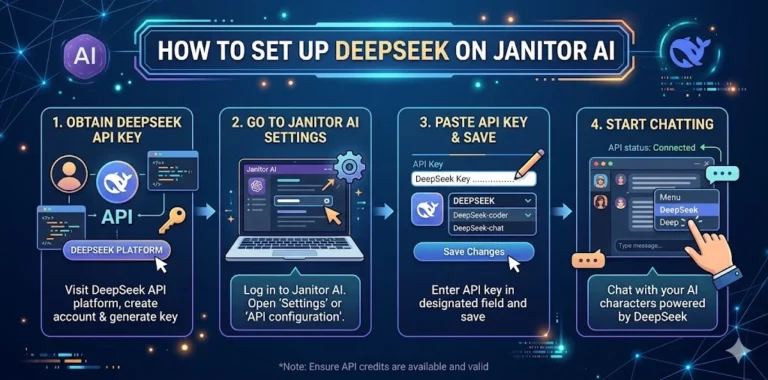
2. DeepSeek API (platform.deepseek.com) Developer access to DeepSeek models for building applications. Significantly cheaper than OpenAI API pricing. Supports OpenAI-compatible request format, making integration straightforward for existing projects.
3. Self-Hosted Deployment Download the open model weights from Hugging Face and run them locally using tools like Ollama, LM Studio, or vLLM. Requires capable hardware for larger models but provides full data privacy and no per-token costs.
| Feature | DeepSeek R1 | GPT-4o | Claude 3.5 Sonnet | Gemini 1.5 Pro |
|---|---|---|---|---|
| Developer | DeepSeek | OpenAI | Anthropic | |
| Open Weights | Yes | No | No | No |
| Reasoning Strength | Very High | High | High | Moderate-High |
| Coding Performance | Excellent | Excellent | Excellent | Good |
| Local Deployment | Yes | No | No | No |
| API Cost | Very Low | High | Moderate | Moderate |
| Data Jurisdiction | China | USA | USA | USA |
| Content Filtering | Moderate (China-aligned) | Moderate | Strong | Moderate |
Data Privacy: The Honest Picture
This deserves a direct, clear answer because it’s one of the most common concerns about DeepSeek.
When you use the DeepSeek web app or API hosted by DeepSeek, your data travels to and is processed on servers in China. DeepSeek, as a Chinese company, is subject to Chinese law including laws that require technology companies to share data with government authorities upon request. DeepSeek’s own privacy policy acknowledges data storage on Chinese servers.
For personal use on non-sensitive topics, many people find this acceptable. For business use, enterprise applications, government-adjacent work, or anything involving personal data, regulated information, or trade secrets, the risk is real and should be evaluated seriously.
The practical solution many organizations use is self-hosting: downloading the open model weights and running DeepSeek on their own infrastructure. This eliminates the third-party data concern entirely.
Tools like DeepSeek AI Checker have emerged partly in response to these privacy dynamics helping organizations verify what content was generated through external AI services versus produced internally.
Content Filtering and Censorship
DeepSeek’s models apply content filters that reflect Chinese regulatory requirements. Topics that are politically sensitive in China including the 1989 Tiananmen Square events, Taiwan’s political status, Tibetan independence, and criticism of the Chinese Communist Party are filtered or declined.
This is a meaningful limitation for users who need open-ended access to historical and political information. Users have documented that the same questions answered readily by ChatGPT or Claude receive non-answers or deflections from DeepSeek.
For most professional and technical use cases, this rarely comes up. For journalism, political research, history, or human rights work, it’s a significant constraint.
Is DeepSeek Open Source?
“Open source” is a phrase used loosely in AI, and DeepSeek is a good example of why precision matters here.
DeepSeek releases its model weights the trained parameters that define the model’s behavior under a license that permits commercial use. This means you can download, run, and build products with the models without paying DeepSeek directly.
However:
- The training code and training data are not fully published
- The license restricts using DeepSeek models to train competing models
- The hosted service infrastructure is entirely proprietary
By the standards of the AI industry in 2025, DeepSeek is considerably more open than OpenAI, Anthropic, or Google. But it’s not open source in the traditional software engineering sense.
DeepSeek AI Checker and Content Verification
As DeepSeek usage has grown across content creation, education, and business writing, the question of how to verify AI-generated content has become increasingly relevant. DeepSeek AI Checker is one such tool designed specifically to help users and organizations identify whether text was produced by DeepSeek models.
Unlike generic AI detectors, a purpose-built checker accounts for DeepSeek’s specific output characteristics its sentence rhythms, reasoning patterns, and stylistic tendencies. This is particularly valuable in contexts where content authenticity matters: academic submissions, published journalism, marketing content, and legal or compliance documents.
Understanding how such tools work helps users think more critically about AI content generally. They analyze statistical patterns in text token probability distributions, sentence structure variety, use of hedging language to generate a likelihood score. They’re useful signals, but not infallible verdicts.
The Broader Impact on AI Development
DeepSeek’s existence has reshaped several assumptions:
Efficiency matters as much as scale. The AI industry’s dominant model had been “bigger models trained on more compute = better results.” DeepSeek demonstrated that architectural innovation and smarter training can close much of that gap at far lower cost.
Open weights change competitive dynamics. When a frontier-level model is freely downloadable, it accelerates adoption, spawns a large ecosystem of derivative tools and applications, and makes it very hard for closed-source providers to maintain large price premiums.
Geopolitics and AI are inseparable. DeepSeek’s success intensified conversations about US export controls on AI chips, the competitiveness of Chinese AI research, and what “AI leadership” means in a world where a $6 million training run can produce a model that competes with far more expensive counterparts.
Future Outlook
DeepSeek has signaled continued investment in multimodal capabilities, improved reasoning, and further efficiency work. Given the pace of their output in 2024-2025, the next model generation is likely to push performance benchmarks further.
More broadly, DeepSeek’s influence will continue to be felt even by people who never directly use a DeepSeek model. Their work has pushed every major AI lab to be more thoughtful about cost efficiency, more willing to release open models, and more transparent about training methodologies.
FAQ
What is DeepSeek in simple terms?
DeepSeek is a Chinese AI company that builds powerful language models. Think of it like ChatGPT, but built in China, largely open for download, and notably cheaper to use via API.
Is DeepSeek free?
The web app is free. API use requires credits but is priced much lower than alternatives. Model weights are free to download for self-hosting.
Who created DeepSeek?
DeepSeek was founded in 2023 by Liang Wenfeng as part of the High-Flyer hedge fund group, based in Hangzhou, China.
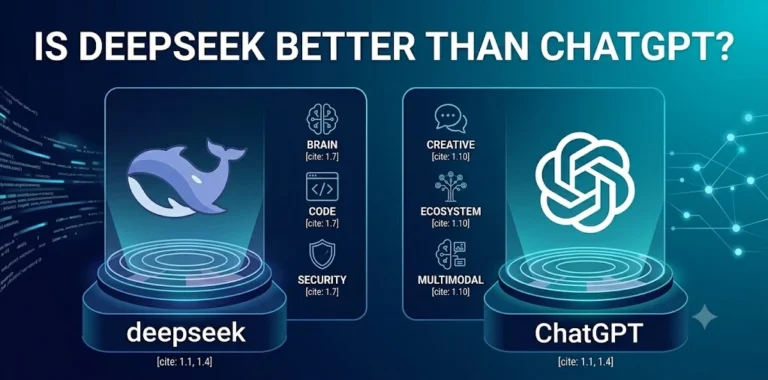
Is DeepSeek better than ChatGPT?
It depends on the task. On reasoning and math benchmarks, DeepSeek R1 is competitive with or better than GPT-4o. On multimodal tasks and ecosystem maturity, GPT-4o has an edge.
Can I use DeepSeek locally without sending data to China?
Yes. You can download the model weights from Hugging Face and run them locally using Ollama, LM Studio, or vLLM.
Does DeepSeek censor certain topics?
Yes. Topics politically sensitive in China including Tiananmen Square, Taiwan, and criticism of Chinese leadership are filtered or declined.
Is DeepSeek safe for business use?
For sensitive business data, using the hosted service carries real privacy risks due to Chinese data jurisdiction. Self-hosting is the recommended approach for enterprise use.
What makes DeepSeek’s training cost so low?
Key factors include the MoE architecture (fewer active parameters per token), the MLA attention mechanism (lower memory cost), and the GRPO reinforcement learning approach (no separate value model needed).
Does DeepSeek have a mobile app?
Yes, available on iOS and Android.
What is DeepSeek R1 used for?
R1 is optimized for reasoning-intensive tasks: math, logic, science, complex coding, and multi-step problem solving.
Is DeepSeek’s open-weight license truly permissive?
It allows commercial use but restricts using DeepSeek outputs to train competing models. Review the full license before building commercial products.
How does DeepSeek compare to Meta’s Llama models?
Both are open-weights models. DeepSeek V3 and R1 generally outperform Llama 3.x on reasoning benchmarks, while Llama benefits from Meta’s larger developer ecosystem.
What happened to NVIDIA’s stock when DeepSeek launched?
NVIDIA’s stock fell sharply approximately 17% in a single day following DeepSeek R1’s release, as investors questioned whether GPU demand assumptions remained valid.
What is the DeepSeek API base URL?
https://api.deepseek.com/v1 it’s OpenAI-compatible in format.
How does DeepSeek AI Checker help verify content?
It analyzes text for statistical patterns associated with DeepSeek model outputs, providing a probability score for AI generation. Useful for editorial, academic, and compliance workflows.